

Everybody's Watching the Wrong Map
Three million acres made the news Monday. The sentence that matters ran Tuesday morning, in the fine print, while nobody was looking.

This past Monday, the President signed an order reducing Bears Ears National Monument by roughly 91 percent and Grand Staircase-Escalante by about 90 percent. That is close to three million acres. It is the largest rollback of protected public land in the country’s history. By nightfall, every conservation feed in America had a take on it. If you were plugged in, you heard about that one.
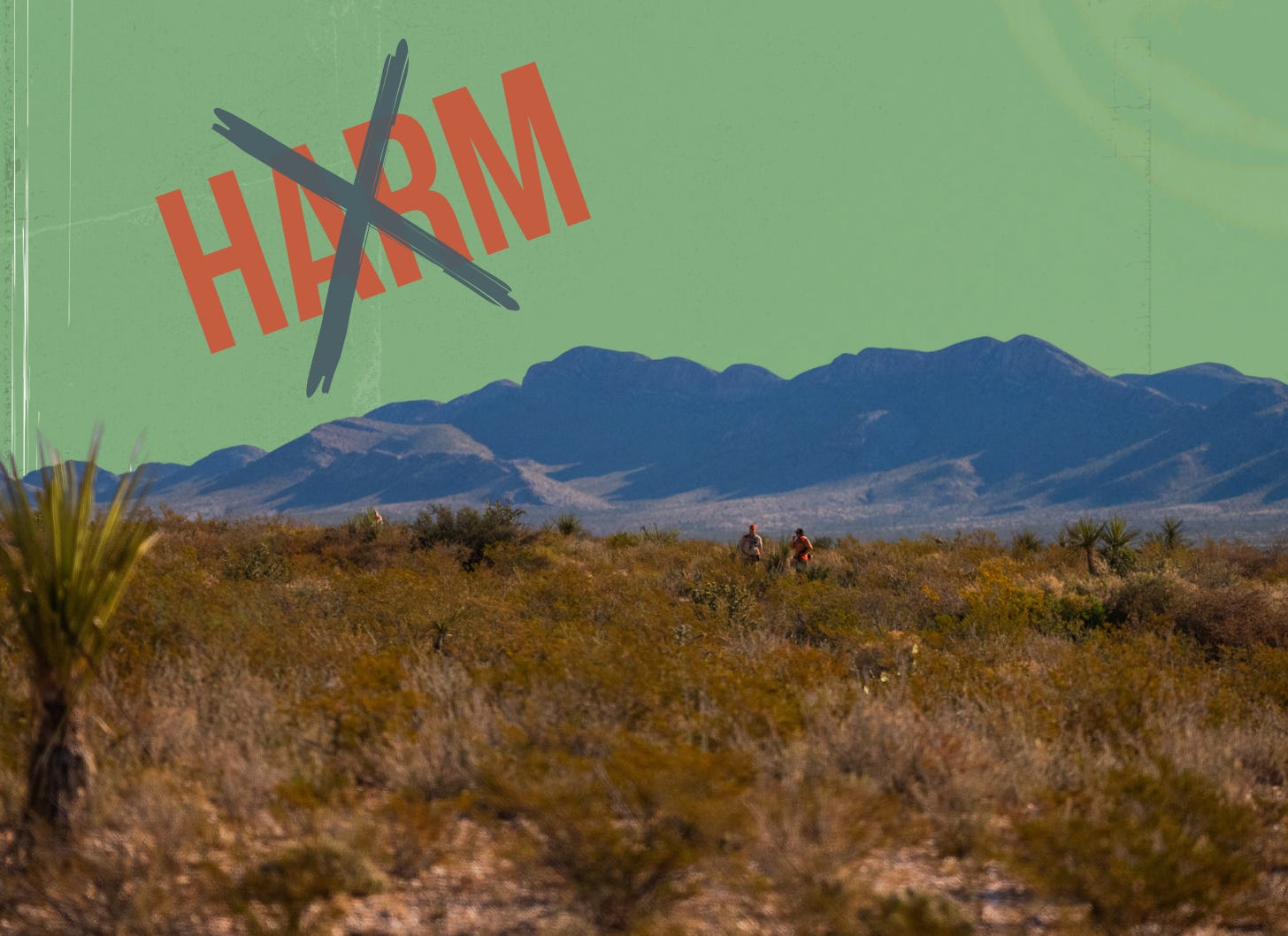
On Tuesday morning, two federal agencies deleted one word from American law. Everyone was still arguing about the map. The odds are good you never heard about it. The two agencies are the Fish and Wildlife Service and the National Marine Fisheries Service. They enforce the Endangered Species Act. The word is “harm.” Come September 14, the ground an animal lives on is no longer part of what the law protects. I do not think the timing was an accident. It has the feel of a distract-and-grab.
Two stories in one week. Start with the map. It is the one everybody is already looking at.
At the signing table the President described the country inside the old boundaries this way: “You can’t do anything. You can’t go hunting. You can’t go fishing. You can’t do anything.” Every word of that is false, and the way it is false is the point. You can hunt Bears Ears. A monument on BLM or Forest Service ground is not a national park. Elk Ridge earned its name honestly and sits right inside the old boundary, and hunters pack quarters off that high country every fall, past ruins older than the country that claims them. Utah’s Division of Wildlife Resources still runs the San Juan unit this season under the designation: elk, deer, desert bighorn. The monument’s own 2024 rules ban target shooting and then carve right back out “the use of firearms in the lawful pursuit of game.”
The man who signed away three million acres does not know what the designation actually did. It closed that country to new roads and new mineral leases. Nothing more. Rescinding it buys hunters neither a season nor a tag. It buys drill pads and cheatgrass up the road cuts and silt in the springs the deer water from. That bill comes due slowly. Ten years out it lands on an agency already stretched past its staffing. You gain nothing you could walk to this fall. What you lose shows up on the ground a decade from now.
The people cheering the order are not fools, and I want that said. Bears Ears has been designated, cut, restored, and cut again in ten years. Four administrations did that to it, and not one of them asked San Juan County first. That grievance is earned. And you know where I come down anyway. Not as a political team, but because I hunt and fish public land, the ground you and I own in common, and I have watched what happens to country nobody is assigned to keep whole. That is what makes the word worse than the map. A map can be redrawn. This one has been redrawn four times in a decade. A word is harder to put back.
Which is why Tuesday matters more than Monday. For fifty years the law’s ban on “taking” a protected animal has included harming it. And harming it has included destroying the habitat it cannot live without. Drain the marsh. Doze the winter range. Dewater the spawning gravel. The law counted all of it the same as a bullet. Harm is the word the two agencies just deleted. On September 14 it is gone.
And unlike Monday’s order this one is not about Utah. The Endangered Species Act runs everywhere the country does: every state, every county, public ground and private. Maybe you fish a river with a listed salmon or steelhead run. Maybe you train dogs in longleaf country or lease bottomland that holds something on the list. The word standing between that habitat and a permit to erase it was harm. The leading reason a species lands on the list is habitat loss. Not hunting pressure. Not poaching. It is about to become the one cause the law no longer names.
The change is simple to state. Under the old rule, wrecking the habitat a listed animal depends on counted as taking that animal. Someone could be made to answer for it. Under the new rule, enforcement needs a direct act against the animal itself. The bulldozer is legal so long as it does not hit the den. Anyone who has hunted a covert the year after it was cleared knows how much protection that leaves. The animal does not die the day the ground goes. It just stops being replaced. No single hand did it.
The hunters of America’s past worked this out a century ago. You can close a season and outright ban hunting a species and still watch it decline if habitat keeps disappearing. Just ask anyone who chased bobwhite through the Southeast in the past decades. If season length and bag limits are the knobs everybody argues about, then habitat is the machine. That is the oldest working knowledge in American conservation. On September 14, this common sense will be removed with the changing of one word, and the impact could be cataclysmic.
The rule is final and no comment period is coming. Next Wednesday I will take the word apart: where it came from, what it held for half a century, what these next two months are for. There is a lever left. It runs through Congress. I will show you where to put your hands on it.
None of what I do here is charity work. This land is yours. The elk up on Elk Ridge and the ducks in your marsh are held in trust for you. The system that keeps them there was paid for by hunters and anglers before either of us was born. Watching the paperwork is just maintenance on something you already own.
The map made the news. The word is the ballgame. The loud stories will always find you. The fine print needs a desk. This is that desk. Wednesday’s piece is where the real work starts.