


Most mornings, nothing happens for a long time. You walk in under a headlamp, find a place, and sit down against it. The light comes up gray and then gold. Your feet go cold. A bird you can’t name starts up somewhere off your left shoulder, goes quiet, starts again. An hour passes, then another, and you have not done a single thing that would photograph well. That, it turns out, is most of what hunting is.
I didn’t know that going in. Like a lot of people who come to this as adults, I thought the whole thing was the shot. I came to it late, through the kitchen door, and I’d built the practice in my head around a single moment: the rifle, the animal, the half-second between them. Almost none of it is that. The half-second is real, and I’ll get to it. But it sits at the far end of a long stretch of doing nothing in particular, and the doing-nothing is the part that rearranged me.
What the waiting does, if you let it, is make you pay attention. Not the frantic attention of a screen, which takes in everything and holds none of it. The other kind. You sit still long enough and the country starts to resolve. You learn that the does favor the same edge most mornings, that the wind swings around an hour after first light, that the gray bird off your shoulder is a titmouse and that it falls silent when something is moving that you haven’t picked out yet. None of this is in a book. You acquire it by sitting in one place, season after season, until the place becomes legible. I’ve written before about the long stretches between birds, the hours that are just weather and patience and a dog working a draw, and how that emptiness is not downtime between the real parts. It is the real part.
Aldo Leopold put the stakes on it more cleanly than I can. We can be ethical, he wrote, only in relation to something we can see, feel, understand, or otherwise have faith in. You cannot be responsible to a piece of country you’ve never bothered to learn, and learning it is slow, unglamorous, mostly invisible work. A West Texas rancher I hunted with told me once that I was trying to hunt the bird when I should have been learning the grammar of the country first. He was right, and the lesson outran the quail by a wide margin. The animal is the last word in a sentence the land has been writing all season. You don’t get to read the last word until you’ve read the rest of it.
This is the thing I think a lot of busy people are actually circling, even when they think they want the half-second. A life spent on inputs and outputs, on the frantic kind of attention, leaves a person starving for the slow kind. Hunting is one of the last respectable reasons left to sit in one place for six hours and do nothing but watch. That and bird watching, which is honestly what a good hunt feels like most of the time anyway. The watching is not a means to the animal. It’s the cure, and the animal is incidental to it.
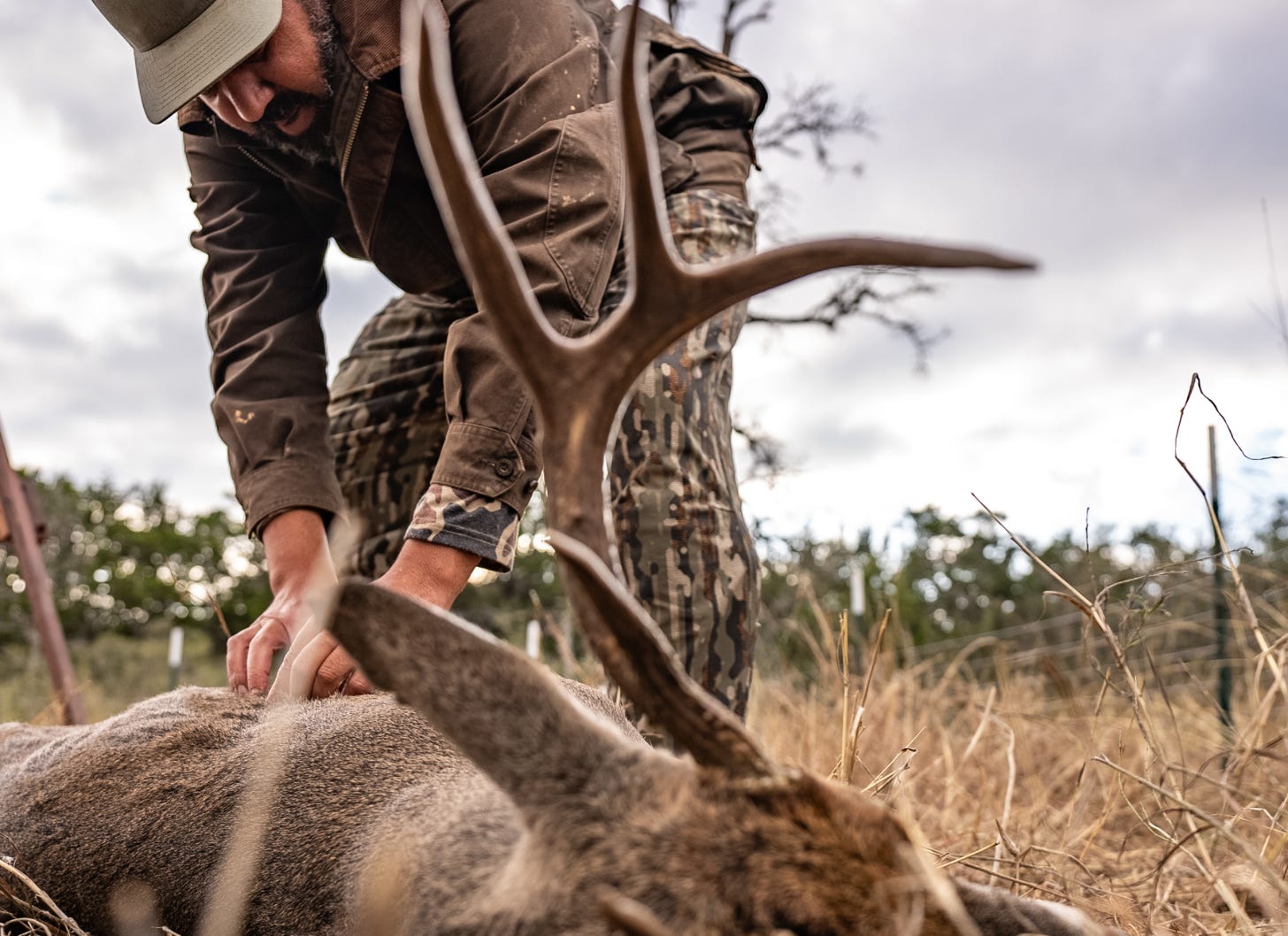
I won’t walk you back through my first deer. I’ve told that story already, the December morning, the borrowed Marlin, the four does at seventy-five yards, the thing I felt when I knelt down that I had no preparation for. What matters here is what the moment did, not the moment itself. I had braced for something like triumph, or at least for the clean satisfaction of a loop closing. That isn’t what showed up. What showed up was weight. The animal was dead because I had decided it would be, and the whole chain that followed, the field dressing and the pack-out and the meat and every meal that would come off it, was now mine to carry honestly or not at all. Reverence is the nearest word and it’s still not right, because reverence sounds passive and this was a job. I had gone out looking for an experience. I came home with an obligation. You cannot un-feel it, and after a while you stop wanting to. Almost every adult-onset hunter I’ve talked to describes some version of that first kneeling-down, the surprise of it, the way the moment refuses to be the clean trophy the culture sells. We brace for a feeling we’ve seen on a wall and we get an older, heavier one instead. Nobody warns you, because there’s no good way to say it that doesn’t sound like a sermon. You have to be the one holding the knife.
I had been cooking and in the restaurant business for most of my adult life when this happened, which is the part that embarrasses me a little to admit. I thought I understood food. I’d built a career on understanding food, on sourcing and butchery and a serious cook’s respect for the animal, all the right language. Then I cooked something I had killed and cleaned myself, and I understood that I’d been working with only the back half of the story the whole time. The line I was so proud of, the one that ran from the farm to the plate, turned out to be a short segment of a much older one that ran back through the gut pile and the long sit and the cold morning and the season that grew the animal in the first place. No farm visit ever showed me that. Nothing in any kitchen had. The first meal I made from my own animal hit harder than anything I’d ever sent out under my own name, and it wasn’t the flavor that did it. It was that I finally knew the entire sentence I was cooking from, start to finish. Every plate since has had that distance folded into it, whether anyone eating it knows or not.
So that is what I mean by the practice. The waiting, the weight, and the cooking. Not the gear, not the trophy, not the half-second. The practice is learning to sit in a place until it tells you something true, accepting what the kill sets on your shoulders, and then cooking the result like it matters, because by then you know exactly how much it does. It is the slow, whole-animal, whole-season version of an act most people only ever meet at its fast and frictionless end. Somewhere in those first few seasons, I stopped thinking like a chef who cared about sourcing and started becoming something harder to name, a cook whose kitchen now began out in the country, months before the stove.
This September I’m teaching it in the order I had to learn it. Six days at Paint Rock Canyon. A Swarovski Optik event at Ranchlands, with Dometic in the kitchen. Observation first, and longest, because everything downstream depends on it. Then range, where the shot gets the time and the precision it deserves, because a clean one is its own form of respect and there is no shortcut to it. The hunt. Butchery. The table. Sand County Almanac is on the reading list, along with some Mary Oliver, because she paid closer attention than nearly anyone and had the discipline to write it down. It’s a small group, and we run it once a year.
If any of this is the thing you’ve been circling, here’s where to read the rest.
I came to all of it the long way in. You don’t have to.
Excellent Josh. This post should be a pre-requisite for all cooks.
I can’t recall where I heard or read it, but it’s a thought that has always stuck with me about the hunting experience: “I stood for a moment in the oldest stillness on earth.”